
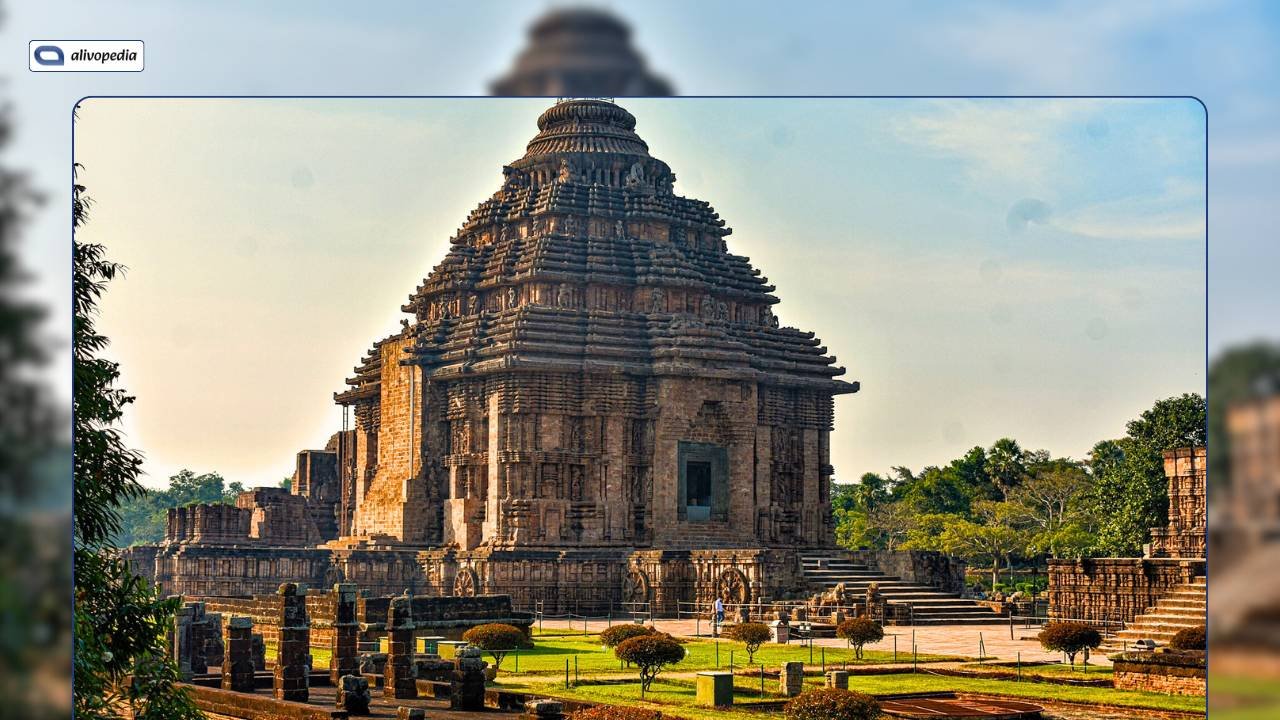
The Konark Surya Mandir, standing proudly on the eastern coast of Bharat in Odisha, is not just a temple—it is a breathtaking fusion of architecture, astronomy, engineering, symbolism, and artistic brilliance. Built in the 13th century by King Narasimhadeva I of the Eastern Ganga Dynasty, this temple was envisioned as a colossal chariot of the Sun God, Surya, drawn by seven majestic horses. Every stone of this monument reflects the advanced scientific understanding, aesthetic mastery, and spiritual depth of our ancestors. Today, the Konark Sun Temple remains one of the most astonishing marvels of Hindu itihaas, inspiring millions with its grandeur and hidden scientific precision.
The Mandir was constructed on the shores of the Bay of Bengal, positioned in such a way that the first rays of the rising sun would fall directly on the sanctum (Garbhagriha), illuminating the idol of Bhagwan Surya. Even though parts of the original structure have collapsed over time, the surviving sections demonstrate engineering skills that remain unmatched even today. The UNESCO World Heritage Site is often described as “poetry in stone,” and for good reason—the craftsmanship speaks a language of its own.
One of the most striking aspects of the Konark Surya Mandir is its design as a massive, stone-carved chariot with twelve enormous wheels—six on each side. These wheels are not mere artistic elements; they are highly sophisticated sundials capable of measuring time with remarkable accuracy. The precision carved into each spoke and engraving reflects the advanced astronomical knowledge of the temple’s creators. These wheels could determine the exact time of day using the shadows cast by the sun, functioning as giant stone clocks centuries before mechanical clocks were invented in Europe.
Each wheel is about three meters in diameter, with eight major spokes and eight minor spokes. The major spokes divide the day into eight equal segments, while the minor spokes provide even finer divisions of time. When sunlight hits the wheels, the shadows fall on specific markings that help determine the time down to almost a minute. Even today, guides at Konark demonstrate this ancient technology by showing how the shadows move along the carvings. Such accurate timekeeping instruments carved into a temple highlight how deeply science and spirituality were integrated in ancient Bharat.
The Mandir’s alignment itself is a masterpiece of astronomical calculation. The entire structure is built along the east-west axis, ensuring that at sunrise, the sun’s rays travel directly through the entrance, illuminating the deity. According to historical accounts, the temple once had a massive lodestone at its crown. This magnet, combined with strategically placed metal plates, was believed to create a magnetic field that helped maintain the balance of the intricate stone structure. Sailors navigating the Bay of Bengal even referred to Konark as the “Black Pagoda” because the magnetic force interfered with their compasses. Whether these accounts are entirely accurate or embellished over time, they signify the awe the temple inspired among ancient visitors.
The architectural symbolism of the Konark Sun Temple is equally profound. The entire complex represents the cosmic journey of time. The chariot form symbolizes movement, the wheels represent the cycle of time, and the seven horses stand for the seven days of the week, the seven colors of light, and the seven chakras of human existence. Every sculpture tells a story—ranging from divine themes to scenes from everyday life. The walls contain depictions of musicians, dancers, warriors, deities, celestial beings, animals, and intricate geometrical patterns. These carvings reflect not only artistic excellence but also the social and cultural vibrancy of the era.
The temple is also a celebration of dance and music. It is closely associated with the classical Odissi dance form, one of Bharat’s oldest dance traditions. Several sculptures show dancers frozen mid-movement, musicians holding traditional instruments, and rhythm patterns etched into stone. These carvings serve as visual documentation of ancient performing arts, offering valuable insights into Bharat’s cultural heritage.
Beyond its architectural beauty, Konark was a scientific center in its own right. The builders used advanced mathematical knowledge, including concepts of symmetry, proportion, and geometry. The precision of the sundials shows a deep understanding of the Earth’s rotation and the movement of the sun across the sky. The temple’s placement near the tropic of Cancer also allowed the craftsmen to study sunlight patterns throughout the year. Some scholars suggest that Konark served as an ancient observatory where priests and astronomers observed celestial movements and recorded seasonal changes.
The temple also incorporates sophisticated engineering techniques. The stones were interlocked with iron beams, and the surface joints were so precisely crafted that even a blade could not slip between them. The weight distribution was carefully calculated to withstand cyclonic winds from the nearby coast. Despite suffering damage from natural forces and invasions, parts of the temple still stand strong, testifying to the genius of ancient Bharatiya engineering.
The Konark Surya Mandir is not just a place of worship; it is a monument to the scientific brilliance, artistic excellence, and spiritual depth of Bharat. It represents the harmonious blend of devotion and reason, where every stone is both sacred and scientific. In an age when astronomy, architecture, and spirituality were seamlessly integrated, Konark stood as a shining beacon of innovation. Even today, it inspires wonder among architects, historians, astronomers, and spiritual seekers alike.
A visit to the Konark Sun Temple is an unforgettable experience. As you walk through the vast stone chariot, observe the sundial wheels, trace your fingers along the carved patterns, and stand before the monumental horses, you cannot help but feel connected to an ancient civilization that looked at the universe with both reverence and curiosity. Konark reminds us that Bharatiya knowledge traditions were never limited to rituals alone—they embraced science, mathematics, geometry, astronomy, art, and spiritual philosophy in one unified vision.
The Konark Surya Mandir continues to shine as one of the greatest architectural and astronomical masterpieces of Bharat. It teaches us that our itihaas is not merely a collection of stories but a treasure house of scientific wisdom and cultural brilliance. In its silent stones, the temple carries the message that faith and knowledge, devotion and discovery, can walk hand in hand—just as they once did under the radiant sun of Konark.

- जोड़ेश्वर महादेव, गाँव साई, नम्होल, बिलासपुर, हिमाचल प्रदेश - October 8, 2026
- स्व. उषा ठाकुर, गाँव बंदला, जिला बिलासपुर, हिमाचल प्रदेश - October 8, 2026
- त्रिवेणी घाट, नम्होल, बिलासपुर, हिमाचल प्रदेश - October 7, 2026