
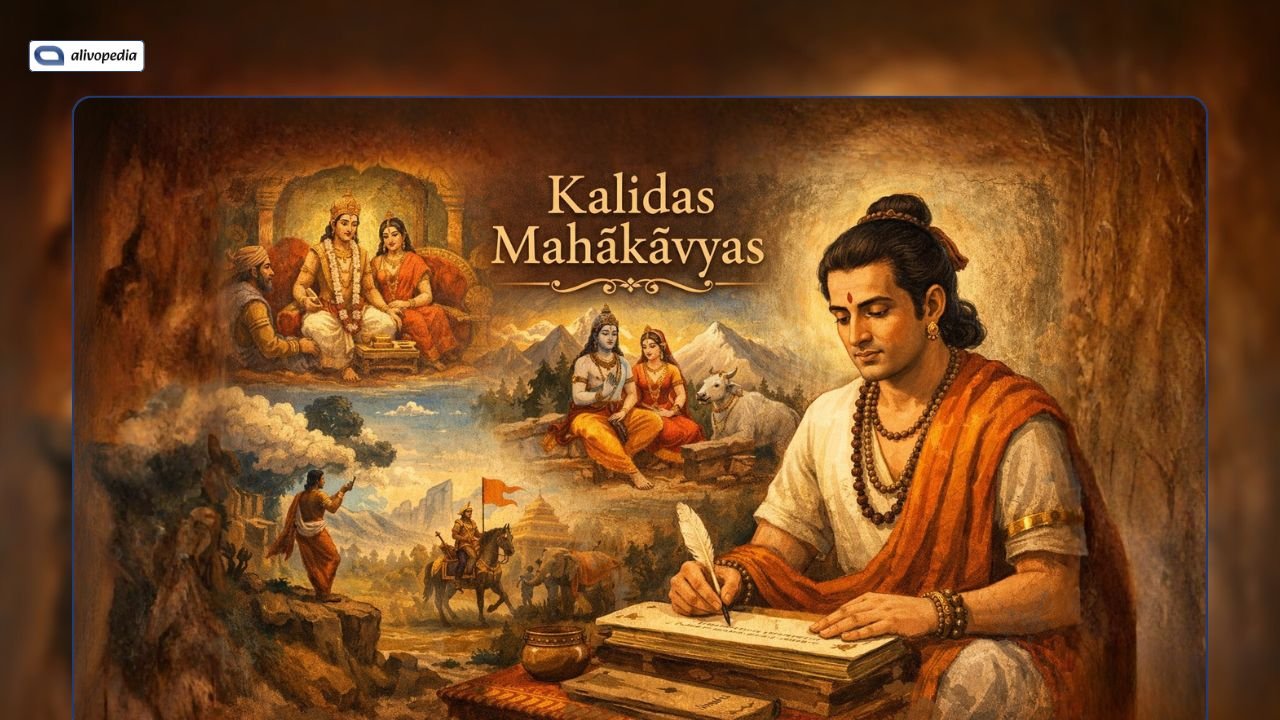
Kalidas Mahākāvya- Kalidas stands as one of the most luminous figures in the history of classical Sanskrit literature. Revered across centuries, he is often regarded as the greatest Mahākāvya poet of ancient Bharat, whose works continue to inspire scholars, poets, and readers alike. His compositions represent the highest refinement of poetic imagination, linguistic elegance, and philosophical depth.
The Mahākāvya tradition, which Kalidas perfected, is not merely a literary form—it is a celebration of life, nature, devotion, heroism, and cosmic order expressed through exquisite poetry.
Who Was Kalidas?
Kalidas is believed to have lived between the 4th and 5th century CE, during the Gupta period, often described as the golden age of Bhartiya culture. Though historical details about his personal life remain limited, his literary legacy speaks with unmatched clarity.
Classical tradition describes Kalidas as a poet deeply attuned to nature, emotions, and the subtle rhythms of human experience. His works reveal a mind that combined aesthetic sensitivity with profound intellectual discipline, making him a timeless literary authority.
Understanding the Mahākāvya Tradition
A Mahākāvya is a classical Sanskrit epic poem characterized by:
- Grand narrative structure
- Heroic themes rooted in Itihaas or Puranic tradition
- Detailed descriptions of nature, seasons, cities, and emotions
- Philosophical undertones blended with poetic beauty
Kalidas elevated this tradition to its highest artistic form, setting benchmarks that later poets could admire but rarely surpass.
Major Mahākāvyas of Kalidas
1. Raghuvamsham (The Dynasty of Raghu)
Raghuvamsham is Kalidas’s most celebrated epic, tracing the lineage of the solar dynasty, culminating in the life of Bhagwan Ram. Through majestic verses, Kalidas presents ideals of kingship, dharma, sacrifice, and moral responsibility.
The poem is admired for:
- Its regal tone and narrative discipline
- Rich character portrayals
- Philosophical reflections on power and duty
Raghuvamsham is not just history—it is a poetic meditation on ideal governance.
2. Kumarasambhavam (The Birth of Kumār)
Kumarasambhavam narrates the divine story of the birth of Kartikey, son of Bhagwan Shiv and Parvati. The epic is especially renowned for its unparalleled descriptions of love, penance, and cosmic balance.
Highlights include:
- Sublime portrayal of Parvati’s tapasya
- Deep symbolism of desire disciplined by restraint
- Harmonization of spiritual and material worlds
This Mahākāvya exemplifies Kalidas’s mastery over both emotion and metaphysics.
Philosophical Depth in Kalidas Mahākāvya
Beyond beauty, Kalidas’s works explore:
- Dharm and ethical responsibility
- Impermanence of power and youth
- Harmony between human effort and cosmic law
His Mahākāvyas subtly guide readers toward reflection, not instruction—making them enduring texts of wisdom.
Influence and Global Recognition
Kalidas’s influence extends far beyond Sanskrit literature. His works have been:
- Translated into multiple languages
- Studied in global universities
- Admired by scholars such as Goethe
He remains a cultural bridge between ancient Bhartiya wisdom and global literary thought.
Why Kalidas Mahākāvya Matters Today
In a fast-paced modern world, Kalidas offers:
- Depth over distraction
- Reflection over reaction
- Beauty rooted in meaning
His Mahākāvyas remind us that true literature elevates the human spirit
Kalidas Mahākāvya represents the zenith of classical Sanskrit poetry. Through Raghuvamsham and Kumarasambhavam, Kalidas established literary ideals that remain unmatched in elegance, depth, and universality.
To read Kalidas is not merely to read poetry—it is to experience civilization thinking in verse.

- जोड़ेश्वर महादेव, गाँव साई, नम्होल, बिलासपुर, हिमाचल प्रदेश - October 8, 2026
- स्व. उषा ठाकुर, गाँव बंदला, जिला बिलासपुर, हिमाचल प्रदेश - October 8, 2026
- त्रिवेणी घाट, नम्होल, बिलासपुर, हिमाचल प्रदेश - October 7, 2026