
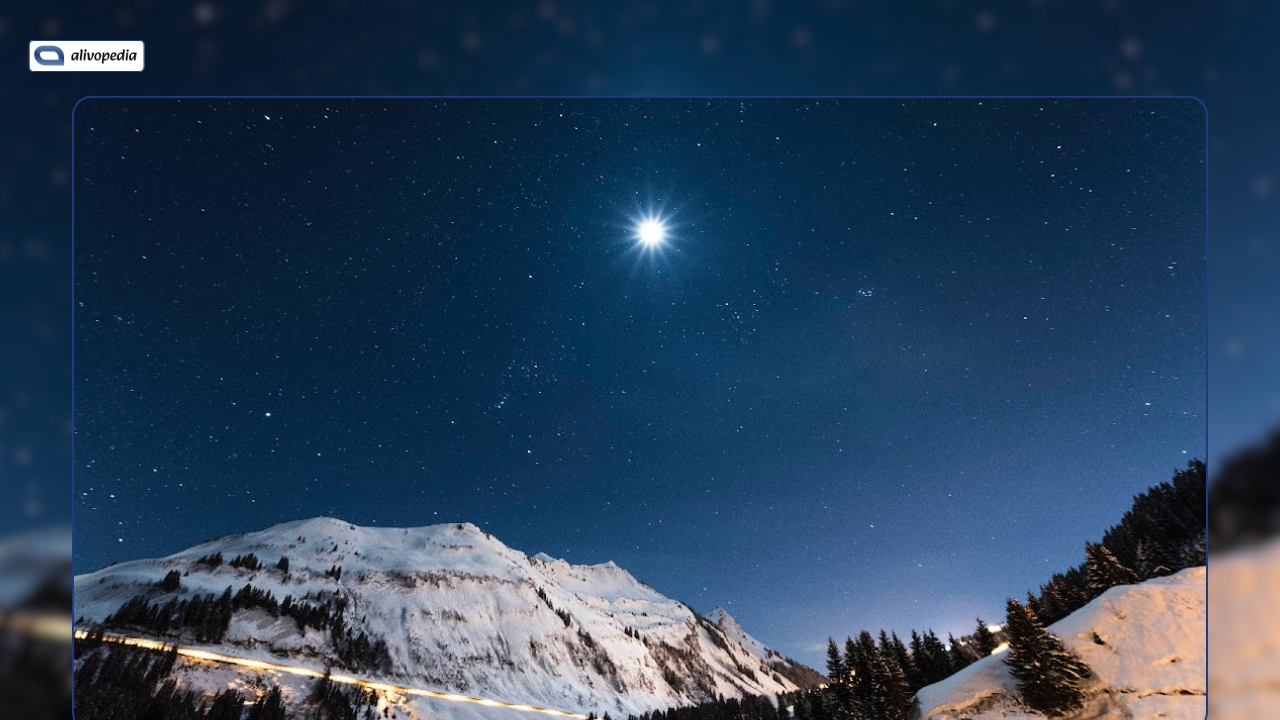
For generations, we have grown up hearing the stories recorded in ancient Sanskrit literature and Hindu itihaas, some of us have heard about Dhruv Tara, assuming that they are only symbolic tales meant to convey spiritual ideas like Moksha. Because of this, people hesitate to look for scientific principles within them and dismiss such efforts as unnecessary insistence. But when we examine these stories carefully, we begin to discover layers of astronomical wisdom hidden beneath the surface.
One such fascinating example is the story of Dhruv, the son of King Uttanapada and Queen Suniti, who earned an eternal place in the sky through intense penance. When Bhagwan Vishnu appears before him, He grants Dhruv a boon that seems poetic at first glance but reveals deep scientific meaning when understood through the principles of astronomy.
Bhagwan Vishnu tells Dhruv, “O Dhruv! I grant you a place above the Sun, Moon, Mars, Mercury, Jupiter, Venus, Saturn, the constellations, the Saptarishis, and all other celestial beings. Some gods live for four yugas and others for a Manvantara, but I grant you stability for a Kalpa.” Many interpreters of Hindu itihaas have described this as Dhruv receiving rulership for a Kalpa. However, the Vishnu Purana clearly states that Bhagwan Vishnu grants Dhruv stability for a Kalpa, not kingship. The term “stability” becomes crucial when viewed through the lens of astronomy, because a Kalpa in this context corresponds to roughly thirteen thousand years—precisely half of Earth’s axial precession cycle.
Our ancient Rishis were already aware of facts that modern science rediscovered thousands of years later. They knew that Earth revolves around the Sun, that Earth rotates on its axis, and that stars do not actually move around Earth; instead, Earth’s rotation creates the illusion that they revolve around us. Among the many stars in the night sky, the one that aligns most closely with Earth’s axis appears almost completely still.
This star, positioned near the northern celestial pole, is known as the Dhruv Tara or Polaris. Although Polaris is 2,200 times brighter and about three times larger than our Sun, it appears small due to its immense distance of approximately 434 light-years from Earth. Because of its near-perfect alignment with Earth’s axis, it seems unchanging and motionless, which is why Hindu itihaas describes Dhruv as immovable, steadfast, and eternally stable.
However, this stability is not truly eternal; it is part of a cosmic cycle. Just like a potter’s wheel that wobbles slightly as it turns, Earth’s axis also undergoes a slow wobbling motion known as precession. It takes about 26,000 years for Earth to complete one full precession cycle. As a result, the star that appears aligned with Earth’s axis gradually changes over thousands of years. This is where the boon of Bhagwan Vishnu becomes scientifically meaningful.
Dhruv remains aligned with Earth’s axis for around 13,000 years—half of the precession cycle. After this period, another star takes over that position. Ancient Rishis had already identified this future pole star and referred to it as Abhijit, known today as Vega. Vega is much closer to Earth, only 25 light-years away, and is the fifth brightest star visible from our planet. It will become the North Star approximately 13,000 years from now.
In the present era, Polaris is still near the North Pole, although not perfectly aligned. Astronomers estimate that by the year 2105, it will achieve its closest alignment with Earth’s rotational axis. After this peak point, Polaris will slowly move away due to precession, and Vega will gradually become the new pole star over the next several millennia. Some astronomers mention that Polaris never fully disappears as a guiding northern marker, but its prominence certainly changes through the ages. This continuous shift between Polaris and Vega perfectly matches the duration described in Hindu itihaas—Dhruv’s stability for 13,000 years, followed by Abhijit’s rule for the next 13,000 years.
Seen through this lens, the story of Dhruv is not merely a spiritual episode but a beautifully encoded explanation of astronomical truth. It combines devotion, cosmic cycles, and scientific understanding in a seamless narrative. The Rishis embedded complex astronomical knowledge within stories so that wisdom could be preserved, remembered, and passed on across generations. The tale of Dhruv stands as a shining example of how Hindu itihaas holds within it a vast reservoir of scientific insights, waiting to be rediscovered by minds willing to look deeper.

- मंत्र शक्ति विज्ञान: ध्वनि, चेतना और ऊर्जा का प्राचीन रहस्य - February 9, 2026
- How ‘Dhurandhar’ and ‘Haq’ Became Global OTT Hits: The Rise of Confident Indian Storytelling - February 8, 2026
- संत रविदास: भक्ति, सम्मान और समाज में समानता का ऐतिहासिक दृष्टिकोण - February 5, 2026